
You ask your child to tidy their room. Ten minutes later they are building something with the toys they were meant to put away. You ask again, then again, and everyone ends up frustrated. For children with ADHD, chores are hard not because they do not care, but because long instructions, invisible time and delayed rewards are exactly what an ADHD brain struggles with. A well-designed chore chart changes that. Here is how to build one that actually works.
Why ordinary chore charts often fail
- The tasks are too big. “Clean your room” is really ten small tasks.
- The rewards are too far away. A reward at the end of the month feels like forever.
- The chart becomes wallpaper. After a week, a paper chart on the fridge is simply not noticed.
- It relies on reading. Younger children, or children who find reading hard, cannot use a text list on their own.
- It turns into nagging. If the parent has to drive every step, the chart has not helped.
7 principles of an ADHD-friendly chore chart
1. Break chores into small, visible steps
Instead of “tidy your room,” use “books on the shelf,” “clothes in the basket,” “toys in the box.” Each step should be something your child can picture and finish in a few minutes.
2. Use pictures, not just words
Pictures are understood faster than text and do not depend on reading. Photos of your child’s own basket, shelf or toothbrush work even better than generic icons.
3. Show one step at a time
A long list can feel overwhelming. Showing the current step big and clear, then the next one, helps children stay focused and feel progress.
4. Make time visible
Children with ADHD often have a hard time sensing time. A visual timer showing how long is left for a task turns “hurry up” into something they can see.
5. Reward quickly and often
Give a small reward, such as a star or point, as soon as a step is done. Let stars add up to bigger rewards the child chose in advance, like extra playtime, a trip to the park or choosing dinner. Quick feedback keeps motivation going.
6. Keep it fresh
Novelty matters for ADHD. Change characters, colors or rewards from time to time, and celebrate finished routines with something fun.
7. Praise effort, not perfection
A bed made a bit crooked is still a bed made. Praise the effort and keep the standard realistic for your child’s age.
Age-appropriate chore ideas
- Ages 3–5: put toys in a box, put clothes in the basket, help set the table, water a plant.
- Ages 6–8: make the bed, pack the school bag, feed a pet, clear their plate.
- Ages 9–11: tidy the bedroom, help with laundry, empty bins, prepare a simple snack.
- Ages 12–14: vacuum a room, load the dishwasher, prepare a simple meal, look after their own schedule.
How to introduce the chart
- Start small: two or three chores, not ten.
- Choose the rewards together with your child.
- Do the routine together the first few times.
- Keep the same time each day so it becomes a habit.
- Review after a week and adjust what is too hard or too easy.
An interactive chart instead of paper
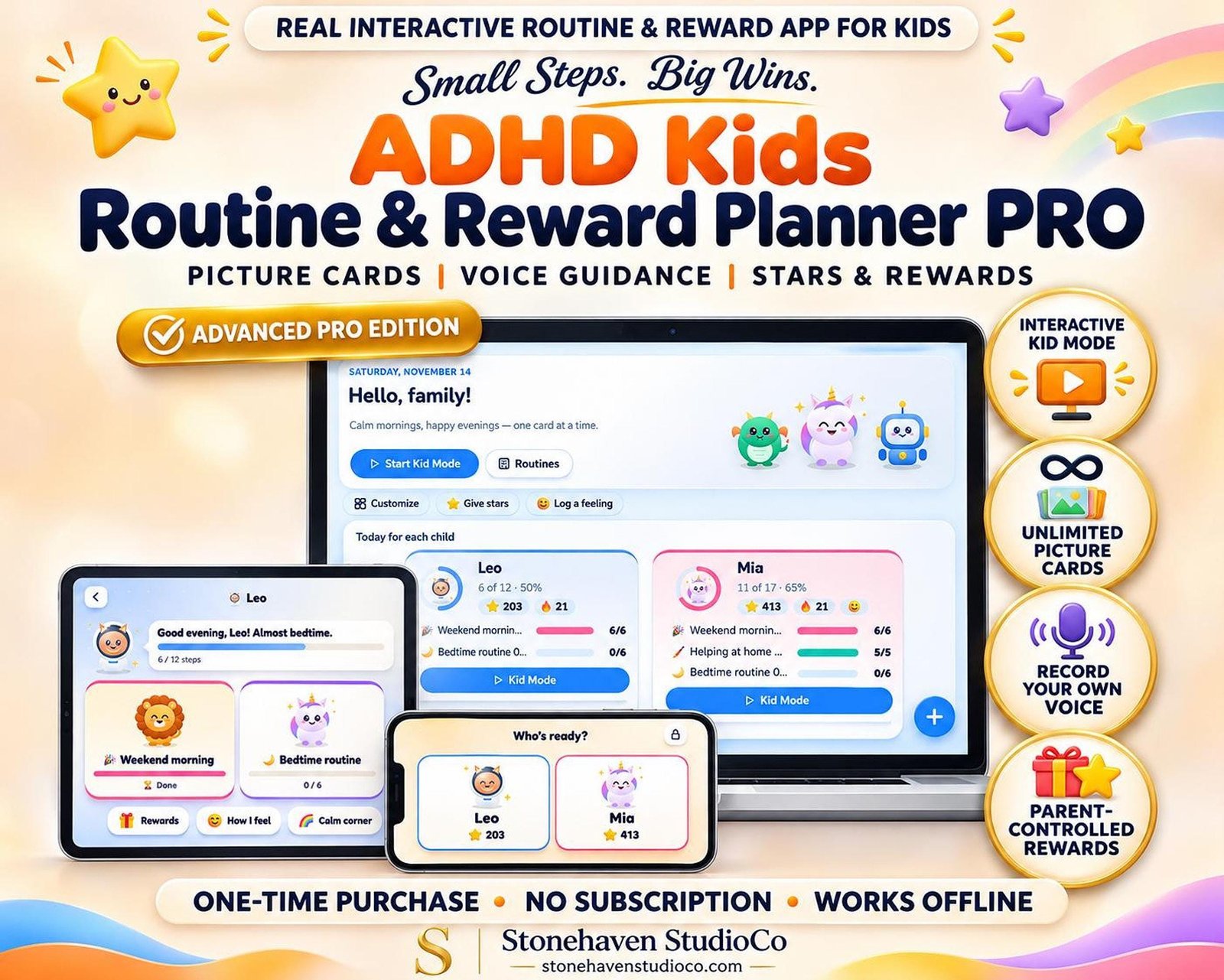
Paper charts get ignored. ADHD Kids Routine & Reward Planner PRO is an interactive app that turns chores and routines into big picture cards your child can follow on their own. In Kid Mode they see one card at a time, watch a visual timer and tap “I did it! ⭐” when each step is done, with a happy celebration at the end.
You can record your own voice for any card and use real photos of your child’s own things. It includes 40 ready-made picture cards plus unlimited cards of your own, friendly characters and routine templates, and a reward chart that makes progress fun. It is made for children aged 3–14, works on tablet, phone and computer, and is a one-time purchase with no subscription. Try the free demo on the product page.
Frequently asked questions
Should children with ADHD be paid for chores?
Some families use money, others use stars, points or privileges. What matters most is that rewards come quickly and are meaningful to your child.
How many chores should a child with ADHD have?
Start with two or three a day and add more only when those have become routine.
What if my child stops using the chart?
That is normal with ADHD. Refresh it with new rewards, characters or chores, and keep your praise frequent.
This article is general information, not medical advice. If you have concerns about your child’s development or behavior, please talk to your pediatrician or a specialist.
Related guide: visual schedule for kids with ADHD.
Leave a Reply